
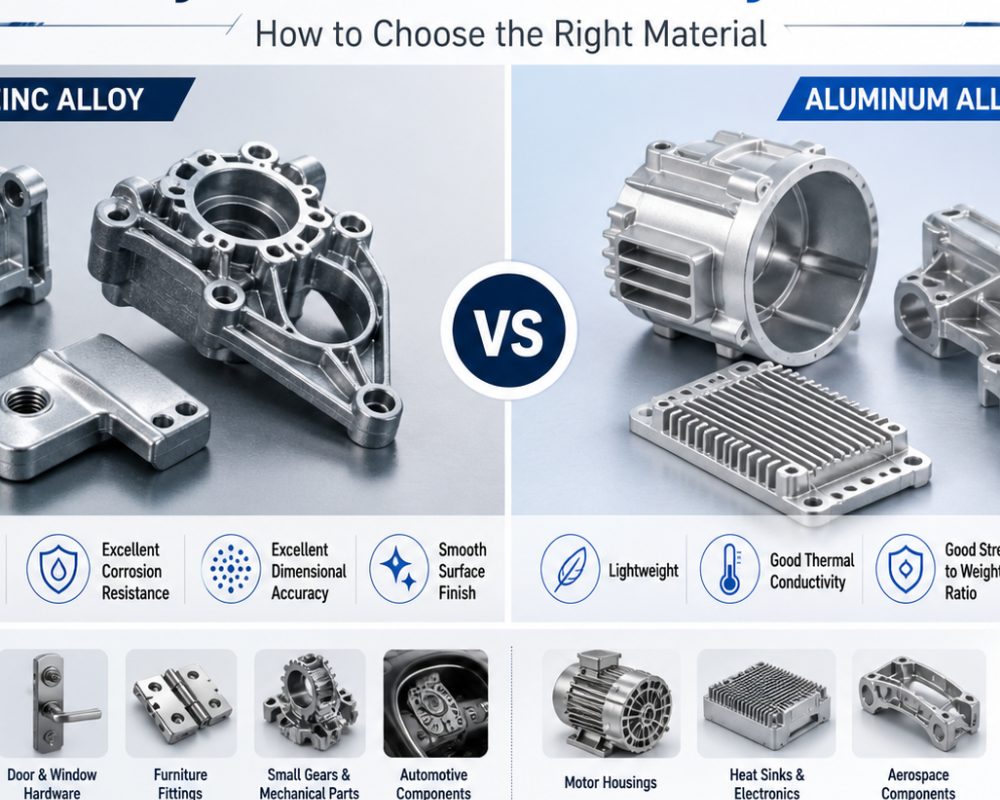
Zinc alloy and aluminum alloy are two commonly used materials in precision die casting. Both materials have their own advantages and are suitable for different product structures and application requirements. Choosing the right material is important for product performance, cost control, and production stability.
Zinc alloy die casting is suitable for parts that require high dimensional accuracy, good surface finish, and complex structures. Zinc alloy has excellent fluidity, making it ideal for thin-wall parts, small precision components, electronic accessories, lock parts, decorative parts, and audio or headphone components.
Zinc alloy parts can also support various surface treatments, such as electroplating, painting, polishing, and powder coating. This makes zinc alloy a good choice for products that require attractive appearance and precise details.
Aluminum alloy die casting is widely used for parts that require lightweight structure, good strength, and heat dissipation performance. Aluminum alloy is commonly used in automotive components, power tool parts, computer server components, optical components, and industrial housings.
Compared with zinc alloy, aluminum alloy is lighter and has better thermal conductivity. It is suitable for larger structural parts or parts used in heat-related working environments.
When choosing between zinc alloy and aluminum alloy, customers should consider product size, weight requirement, strength requirement, surface treatment, tolerance, and application field. For high-precision small parts, zinc alloy may be more suitable. For lightweight structural components, aluminum alloy is often a better choice.
As a professional die casting manufacturer, Jiudian can provide material suggestions based on customer drawings, samples, and product applications.